Mieland: Headless E-Commerce Platform for a Premium Honey Brand
Client: Medusco Group Limited (New Zealand, full remote async workflow)
Stack: Next.js, React, GraphQL, WordPress (Headless CMS), WooCommerce
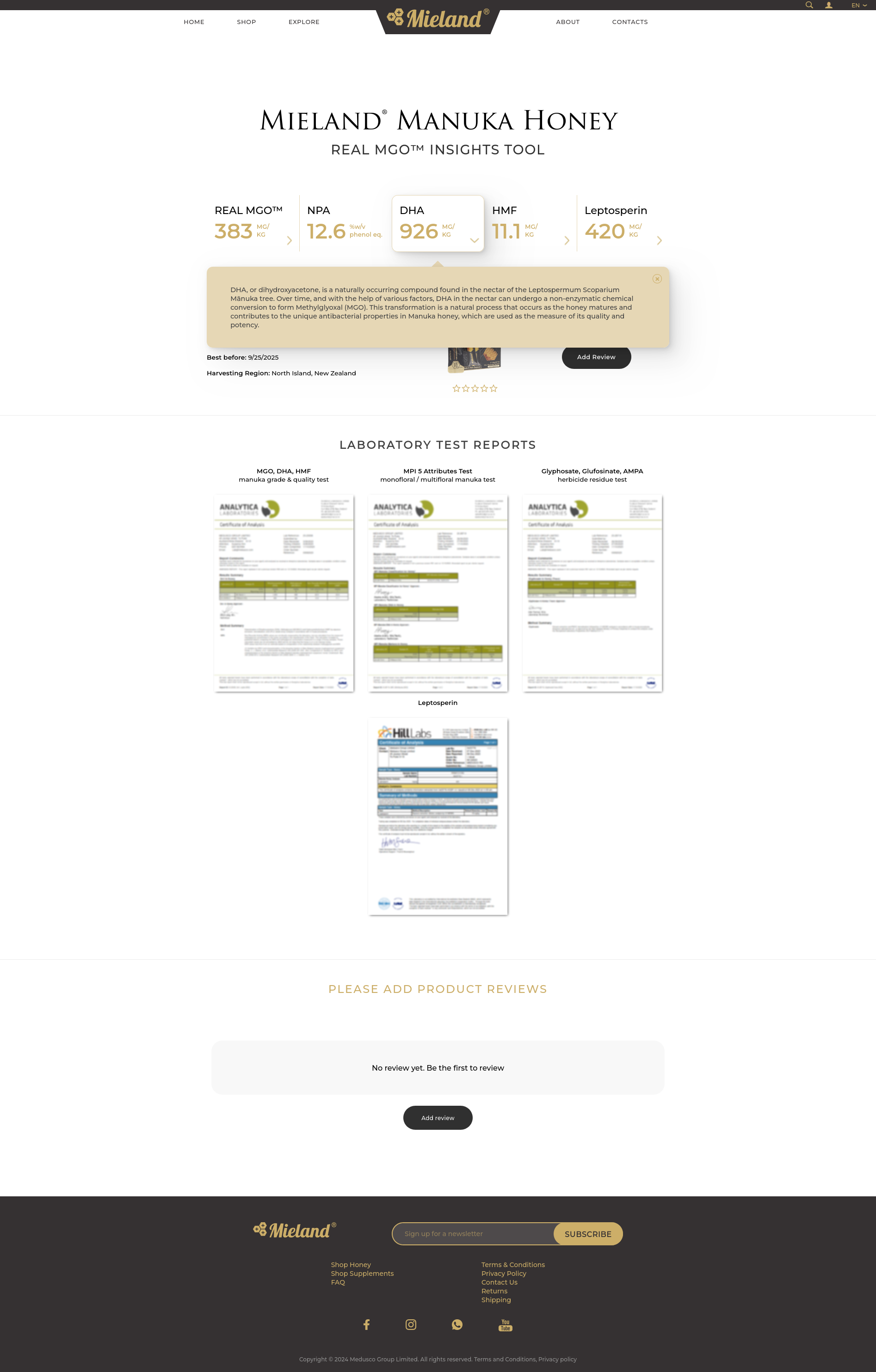
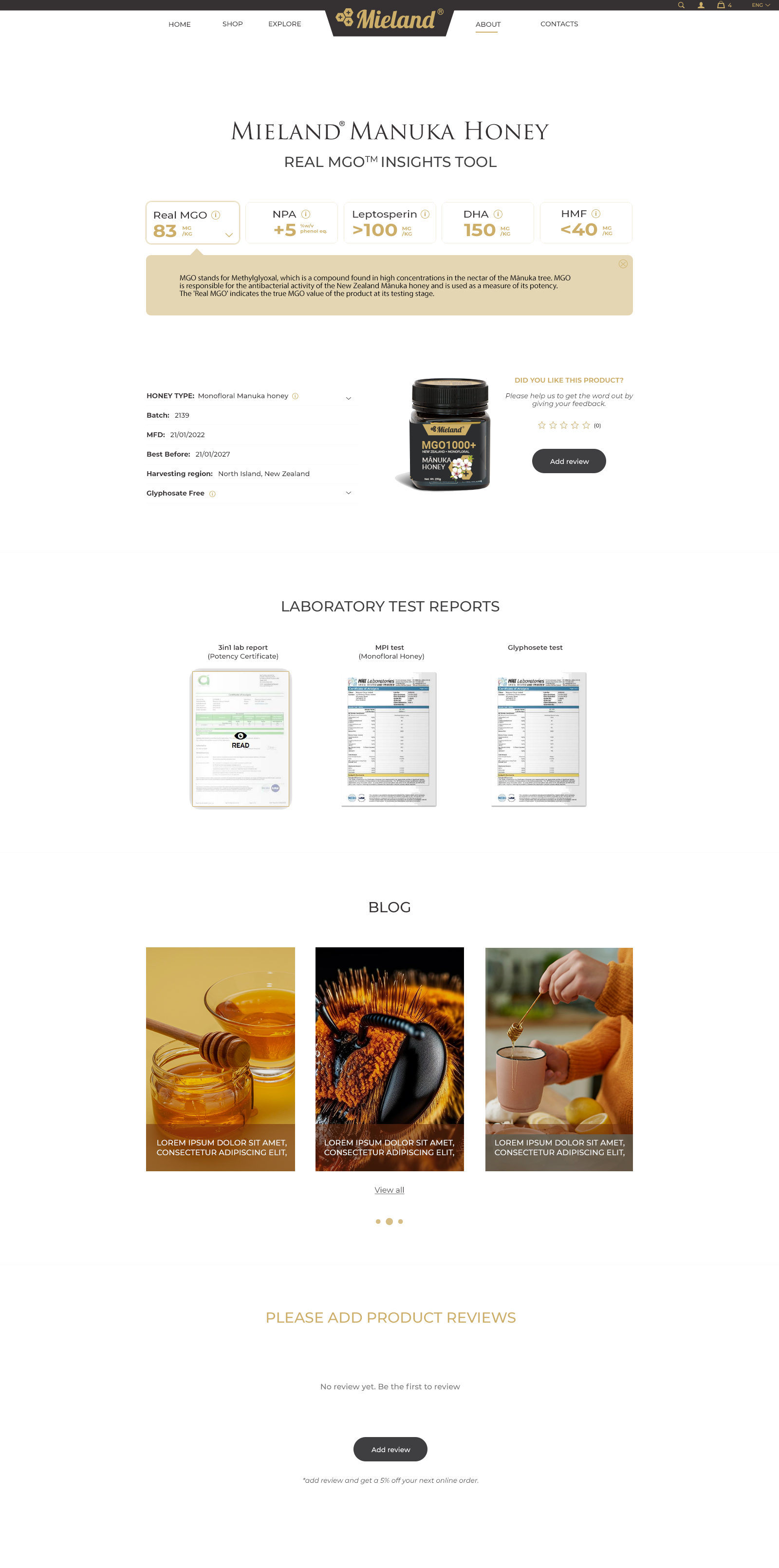
In 2024, I worked with Medusco Group Limited, a New Zealand-based honey producer to improve and extend their headless e-commerce platform: Mieland.
The platform combined WordPress/WooCommerce on the backend with a custom Next.js storefront connected through GraphQL. The architecture gave the business flexibility and performance benefits, but also introduced operational complexity: content modeling, SEO, localization, and commerce logic all had to be coordinated across multiple systems.
Honey Traceability System
One of the main features I designed and implemented was a honey traceability tool allowing customers to retrieve laboratory and origin information associated with a purchased product batch.
Features implemented
- Batch ID search interface
- GraphQL-driven data retrieval
- PDF laboratory report viewer
- Custom front-end UI integrated into the existing brand identity
- WordPress CMS management interface for uploading and maintaining reports
- Error handling and edge-case management
- Internationalization support (i18n)
Technical considerations
The feature required coordinating several layers of the platform:
- custom CMS structures inside WordPress
- GraphQL schema exposure
- front-end querying and rendering
- asynchronous PDF loading
- responsive UI behavior
- localization support
The client needed a workflow that non-technical staff could maintain reliably over time. Laboratory reports had to be uploaded, associated with production batches, localized, and exposed through the storefront without creating additional manual coordination between teams.
The solution centered around a self-service flow where customers could enter a batch number and retrieve the associated information instantly, including PDF reports and origin data.
The engineering work was deliberately shaped around maintainability:
- CMS structures were designed for non-developer use
- data relationships were normalized to avoid duplication
- GraphQL queries were structured to remain predictable as content volume grew
- the front-end experience was optimized for clarity rather than novelty
This significantly reduced operational overhead while creating a customer-facing feature that reinforced trust and product transparency. An important differentiator for a premium food brand.
Custom 3D PDF Viewer
Objectives
- Match the premium visual identity of the brand
- Improve readability compared to standard embedded PDF viewers
- Create a more polished product experience
To improve the presentation of laboratory reports and brand assets, I developed a custom React-based PDF viewer with animated transitions inspired by physical page interactions. A standard embedded PDF solution technically satisfied the requirement, but it created a disconnected experience that felt inconsistent with the rest of the product.
The viewer integrated into the existing design system and provided a significantly more refined interaction model than a standard iframe or browser-native PDF embed. The decision was about reinforcing product quality and trust in contexts where customers were evaluating authenticity and certification information.
Headless Blog Integration
Engineering challenges
Headless CMS setups often look straightforward in isolation, but complexity appears at the boundaries:
- content formatting consistency
- SEO metadata
- localization
- dynamic routes
- preview behavior
- responsive rendering
- CMS/editor workflows
A major part of the project involved implementing the site’s blog and editorial content system within the existing headless architecture (WordPress setup connected to the Next.js front-end through a GraphQL API layer)
The goal was not simply to “connect WordPress to Next.js,” but to make content publishing dependable for the business team while preserving performance and consistency on the front end.
I built the blog system around reusable rendering patterns and predictable content structures rather than page-specific logic. This reduced long-term maintenance costs and made future expansion easier without introducing fragile front-end exceptions.
The outcome was a publishing workflow that allowed the client to scale editorial content without engineering involvement for routine operations.
SEO Improvements
SEO improvements were another important area of work. In traditional WordPress setups, SEO concerns are often handled almost entirely through plugins. In a headless architecture, that abstraction disappears. Metadata, indexing behavior, structured information, and page rendering strategies all become application-level concerns.
The objective was to make SEO behavior reliable and scalable rather than dependent on manual fixes or page-by-page intervention.
This included:
- Dynamic meta title handling
- OpenGraph metadata support
- Product/page-specific descriptions
- Better integration between CMS-managed SEO fields and the Next.js front-end
- Consistent metadata rendering across commerce and content pages
The implementation required coordinating CMS field structures, GraphQL exposure, server-side rendering behavior in Next.js and front-end metadata injection
Outcome
The work ultimately strengthened two core dimensions of the business: perceived product value and customer acquisition.
On the product side, the traceability system transformed what could have remained a back-office compliance process into a customer-facing trust mechanism. By allowing customers to access batch-specific information and laboratory reports directly from the storefront, the platform reinforced the premium positioning of the brand through transparency and product authenticity.
The custom PDF viewing experience supported the same objective. Instead of exposing technical documents through generic embedded viewers, the experience was designed to feel integrated into the product itself, helping certification and origin information contribute to the overall perception of quality.
On the growth side, the headless blog infrastructure and SEO improvements gave the client a scalable foundation for discoverability. Editorial content could be published reliably without engineering intervention, while metadata handling and server-rendered content improved the platform’s ability to surface consistently in search engines.
This project was about using product engineering to increase trust, strengthen brand perception, and improve the long-term discoverability of the business online.